Longplayer, the Bayeux Tapestry, and other news
The rest is silence
Sam Kinchin-Smith writes: I recently inherited my great uncle’s collection of Folio Society editions, which includes a handsome volume from 1973, The Bayeux Tapestry and the Norman Invasion. There’s a line in its introduction, by the philologist and translator Lewis Thorpe, which immediately stood out. Referring to the popular theory that the tapestry was commissioned by Bishop Odo and first displayed at the dedication of his cathedral in Bayeux a decade after the Battle of Hastings, Thorpe writes: ‘After the dedication ceremony in 1077 there followed a silence of some four hundred years.’ The tapestry wouldn’t be referred to directly in a literary source until 1467, when it turned up in a manuscript inventory at the cathedral. Then another 250 years passed, before its second mention in a scholarly paper given in Paris in 1724.
Is an artwork that has survived for a very long time automatically a durational work? The tapestry and its arrival in London have inevitably been on our minds here at Longplayer, because (if the theory about Odo is correct) the fact that it only has 51 years to go until it completes its first Longplayer-length cycle, means it presents us with an artistic portal into thinking about deep time that extends almost as far backwards as Longplayer extends forwards. (We played with this idea last year, with a listening post in the lady chapel at Exeter Cathedral, which was celebrating its 975th anniversary in the same year that Longplayer was marking the fact that it had 975 years still to go.) One of the few aspects of the exhibition at the British Museum that I’ve seen criticised is the soundtrack, so why not listen to Longplayer via our app during your visit (if you’ve somehow managed to get hold of a ticket) and stand at the pivot between timespans of nearly a thousand years in both directions?
Those long silences, when the tapestry was bundled up with drapes and vestments and forgotten about for centuries, serve as a reminder that survival is not always the same as continuation – that indeed, the Bayeux Tapestry’s survival is almost certainly the product of its not having been the subject of unbroken attention since 1077. This is a useful lesson, and one that I know has preoccupied Jem Finer over the years: if keeping something playing for a millennium inevitably requires some long stretches of dormancy – of silence – how can its principles and technologies be engineered in such a way that when future generations stumble upon it, like the vesturers at Bayeux Cathedral, they can dust it off, hold it up to the light, and pick up where their ancestors left off? How can that meaningful intergenerational connection be re-established, re-maintained?
The difference between a durational artwork and one which simply survives is intention. What we can’t know, of course, is whether the anonymous women in Canterbury who were probably responsible for the embroidery of the Bayeux Tapestry, reflected on questions like these as they completed their needlework. I’d like to think that they did.

Note also the startling resemblances between the tapestry’s famous banquet scene and Longplayer Live at the Roundhouse last year.
In other news …
Open House 2026
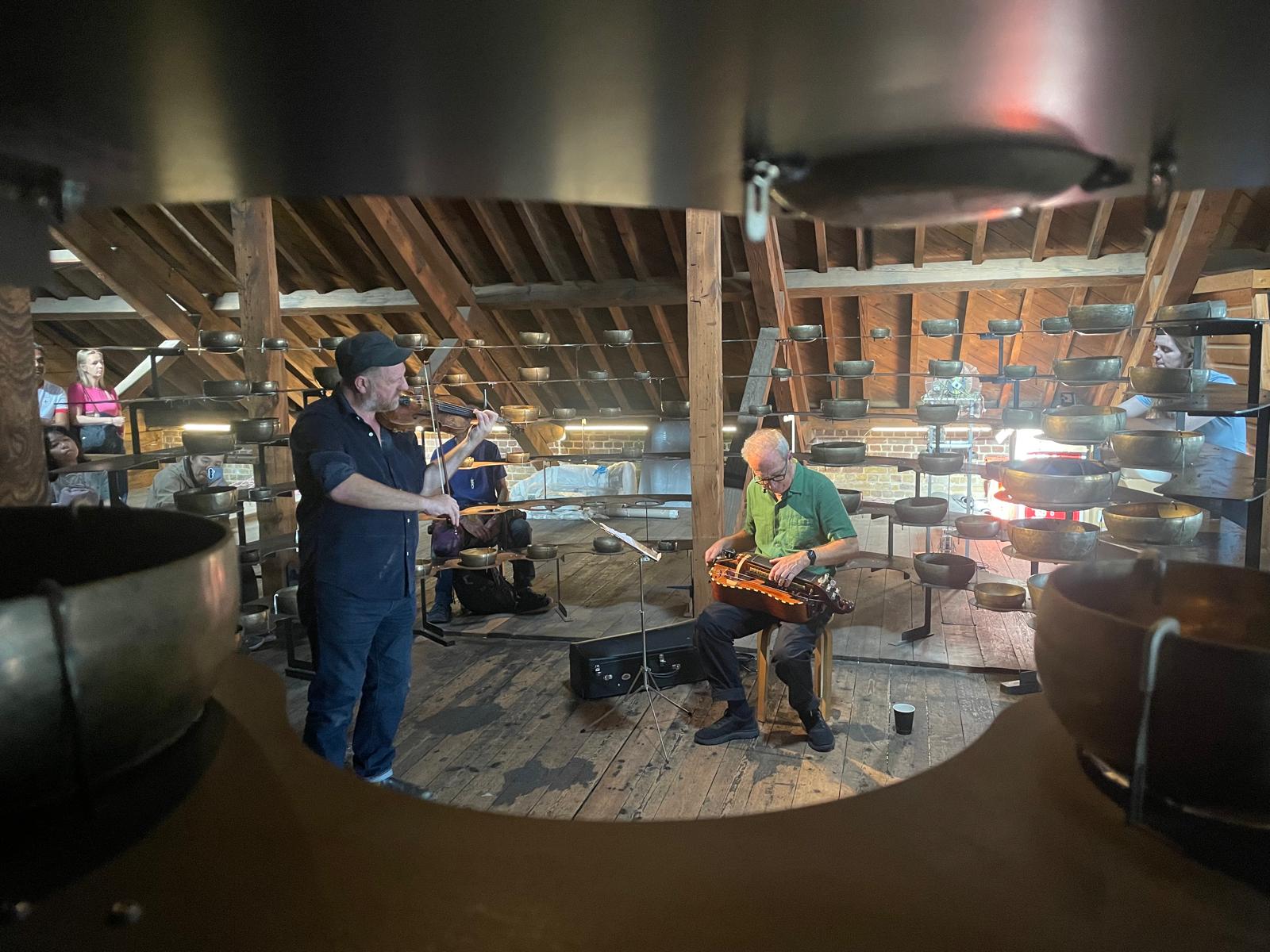
During Open House 2026 we opened the doors of the lighthouse at Trinity Buoy Wharf to welcome hundreds of new visitors to Longplayer, with creative family workshops from artist Kitty Finer, and a special live performance by John Matthias and Jem Finer of music from their recently released album ‘Almost Starlight’, available to stream now or you can purchase the album on cassette or vinyl from Rough Trade.

New Longplayer iPhone App Available to Download
The Longplayer app now includes our new Longplayer audioguide, featuring the voices of Jem Finer and Ansuman Biswas. If you haven’t updated it for a while, do so now!
SPILL Festival
Check out artist Katie Evans’ latest update on her work with SPILL Festival’s Ipswich Time Project, which is running all this year in partnership with Longplayer.