THE ROUNDHOUSE, LONDON 12th SEPT. 2009
The first 1000-minute Longplayer Live performance took place at the Roundhouse, London, on the 12th of September 2009.
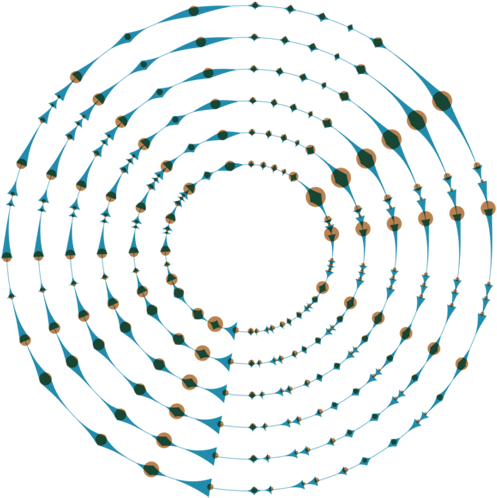
Based on Jem Finer’s graphic score for 234 bowls and six players (see left), Longplayer Live is performed on a 20-metre wide instrument, comprised of six concentric circles of Tibetan Singing Bowls, by an orchestra of 20 musicians.
In order to fund the ongoing construction of this instrument and the production of future Longplayer Live events, The Longplayer Trust is inviting donations on a bowl-by-bowl basis. When you fund a bowl, it will be engraved with a word of your choice.
£1000
£500
£250
£150
£100
£50
After receiving your donation through paypal or bank transfer you will be sent a receipt and confirmation. You may also choose your inscription now or at a later date. Longplayer is a charitable trust, Registered Charity no. 108 7243.
If you don’t wish to buy a bowl but are still interested in supporting Longplayer, please consider making a donation via our paypal account or bank transfer.

Live Performance, Graphical Score
While it plays on in its digital form, Longplayer was conceived as a project which would sustain itself in the near and distant future by seeking new and adaptive strategies for its own continued existence. Research into non-electrical, mechanical and organic implementations of Longplayer began at the time of the project’s initial conception, and both the composer and the Trust have always regarded the original and present day computer-operated Longplayer system as a first (and almost certainly temporary) step in a long process of development and evolution.
Among the suggested systems for the ‘playing’ of Longplayer is a live arrangement for six musicians and 234 Tibetan bowls of varying sizes and pitches. For this, Finer has produced a graphical score (above), by which the deceptively simple system of advancing loops of which Longplayer is composed can be accurately reproduced by live performers.
Longplayer's composition is based on a system in which six sections from a piece of source music are played simultaneously, five of them transposed to different pitches. In the graphic score these find material form as an arrangement of six concentric circular tables, on which are arrayed precisely tuned bowls carefully spaced to correspond with the looped waveform of the original source music.
Beyond the 2009 performance, our long term ambition is to find a permanent home for this orchestral installation, where it can play on into the foreseeable and unforeseeable future.