Good morning, Voyager One
Some reflections by Longplayer Trustee Gavin Starks
At 10:16 this morning (GMT), give or take, something humans made became one light-day old.
Voyager 1 left Earth in September 1977. Since then it’s been travelling at ~17km per second: it has taken 49 years to cover the distance that light covers between your breakfast yesterday and today.
We can imagine one kilometer (you can walk it), or 1.3 seconds (the time it takes for light to get to our Moon). Even though I studied astrophysics, the fact that a light-day is 60 billion kilometers is still not a thing I can easily imagine. So, as usual, I try to look for a different kind of ruler.
Longplayer has been playing for nearly 27 years, and Voyager has been travelling for nearly half a century. When Longplayer completes its first cycle (in the last moments of 2999) Voyager will be about 21 light-days from home.
So, three light-weeks (at the speed of light) after a thousand Earth-years of travel. If it were pointed at the nearest star (it isn’t), Voyager would arrive in around 75,000 Earth-years, or seventy-five Longplayer cycles.
A thousand Earth-years might feel long for a piece of music, and I’ve written before that Longplayer’s timeframe is big, but not infinite. However our perceptions change based on how we imagine it, for example, we can imagine 1,000 years more easily than ‘a billion years’ because we can see and read human history over that period. Can we imagine Longplayer’s 75th loop? Its 1,000th loop?
How would a long conversation feel if it had a two-day pause between sentences?
Imagining Voyager changes our sense of distance: that there is a place, one light-day away, and there we’ve put a machine, and it’s still (just) talking to us, very, very slowly. Send an instruction or a question, wait 24 hours, Voyager will then receive it and reply; we then wait for another 24 hours to get its reply; a light-day in each direction.
What does it mean to communicate when every exchange takes two days? Those who look after Voyager have had decades to learn how to do this: reactions are slow so it is essential to anticipate. Write our instructions, send them, and go home; trust that the machine at the other end will do what it was designed to do, and trust that someone will be there to listen when the response arrives.
A version of this question sits continuously in Longplayer: how do we communicate across generations (40 generations per loop)? Whatever we send forward (code, scores, bowls, instructions, intent, stories) will be received by people who cannot ask us what we meant: for Longplayer, replies will occur in a future generation we cannot imagine. Voyager’s engineers can, at least, get an answer to some questions the day after tomorrow.
Records of note
Voyager also carries a record: Bach, Chuck Berry, Blind Willie Johnson, greetings in dozens of languages, the sound of a kiss have all been pressed into a gold-plated copper record, with instructions for how to play it etched on the cover. We can make only one assumption: that whoever finds it will share nothing with us except mathematics and physics (our truly universal Esperanto).
Longplayer has not [yet :)] sealed music in a capsule into space and let it go. Instead it asks to be kept alive by playing it, talking about it, carrying forward its ideas; by people and/or machines, continuously, through whatever happens next. It’s a relay rather than a message in a bottle: Voyager assumes someone will be out there, Longplayer assumes someone will still be here.
Endings
One element of the Voyager story I find most affecting is silence. As it hurtles through the deep silence of deep space, in order to keep it alive its custodians have been switching off one instrument at a time: its cameras went dark decades ago, other sensors one at a time. Each choice trades a little of what it can do for a little more time in which to do it. It is a long series of careful choices about what is essential, made by those who inherited the job from people who inherited the job.
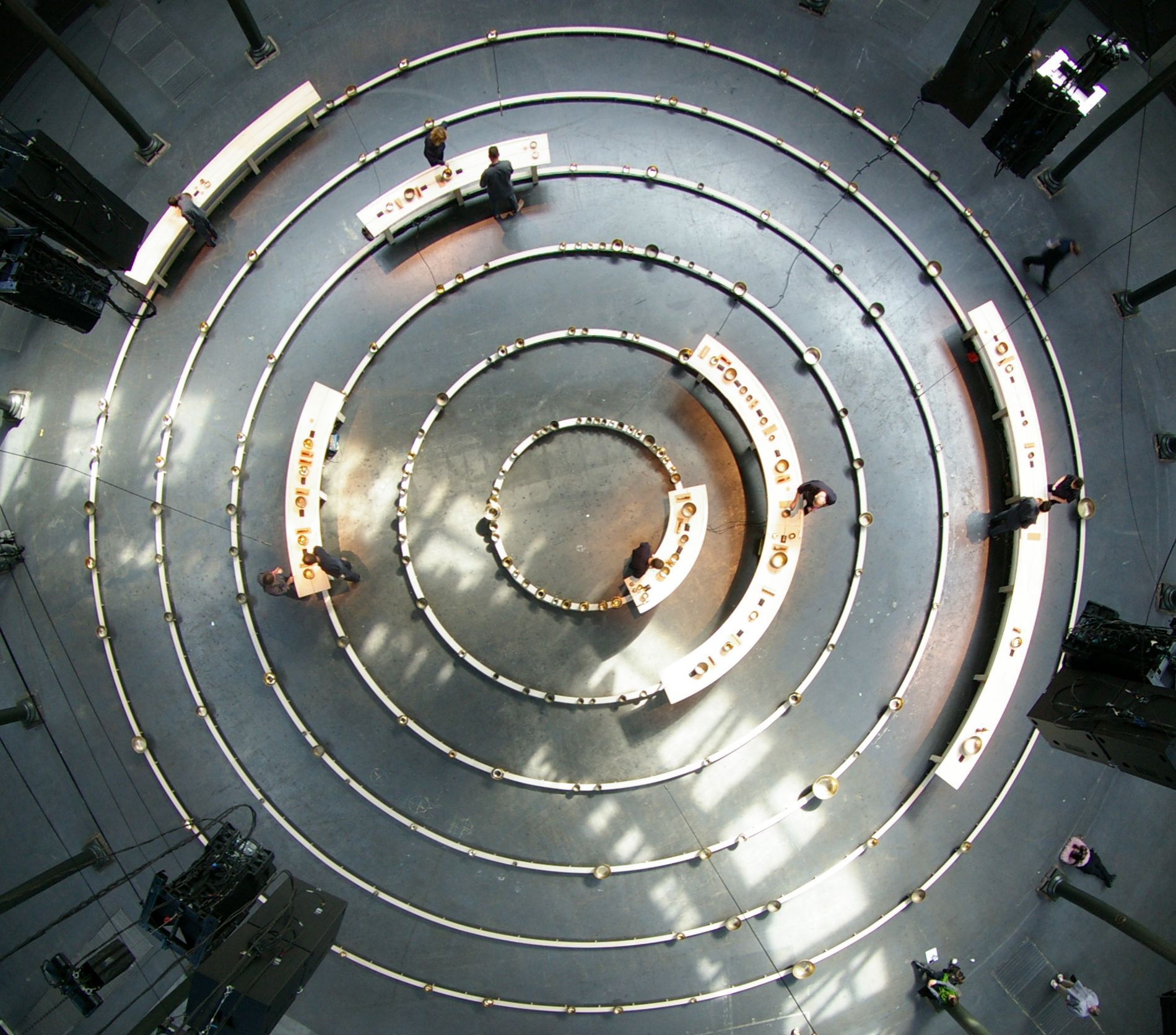
Longplayer started on a Mac running SuperCollider: it now runs in a Python app on a Raspberry Pi, an iPhone and other devices. It has been sung, pressed to vinyl and played by hand on 234 bowls. It is written about, and has been spoken about for a quarter of a century. How will it endure?
We could not plan for these evolutions in 1999, and none of what we can imagine will be the answer in the year 3000. What is the “it” that persists? Certainly it is unlikely to be any of its current hardware, probably not even the software, nor even its native English in its current form. More likely to be transmitted is its intent, its story, a sense of willingness of the next person to pick it up as its custodian: to continue a tradition of belonging.
Voyager 1 captures our global sentiments for exploration, of building on shared endeavour, of history, of the finite infinite, running on a fading trickle of power. As it crosses our human-defined timeframe, we pay attention to its remarkable achievements, we reflect on our past and our futures and we notice.
Links:
- NASA Science: Voyager 1, What Is a Light-Day
- NASA Science: Where Are Voyager 1 and 2 Now?
- IFLScience: Voyager 1 Will Cross The 1 Light-Day Threshold On November 18, 2026
- EarthSky: Voyager 1 to reach 1 light-day from Earth
- ScienceAlert
Longplayer’s 25th anniversary performance at the Roundhouse in 2025, celebrating a musical composition designed to play continuously for 1,000 years, from 2000 to 2999