About Longplayer’s Survival
From its initial conception, a central part of the Longplayer project has been about considering strategies for the future. How does one keep a piece of music playing across generations? How does one prepare for its technological adaptability, knowing how few technologies have remained viable over the last millenium? How does one legislate for its upkeep? And how can one communicate that responsibility to those who might be looking after it some 950 years after its original custodians have perished?
Technological Survival and Possible Solutions
The first question about Longplayer’s survival is technological – by what methods will its music be produced, how will it be heard, and how will those technologies have to change in the face of the next thousand years of environmental challenges and unforeseeable circumstances? There are several different alternatives being pursued at the moment, among them:

1. A dedicated global radio frequency, the original and abiding ambition for Longplayer. At present Longplayer is being streamed live on the internet – a medium which, while at present truly global and virtually instantaneous, depends on both a vast, complex, and somewhat unstable technological network for it broadcast and a high technological “overhead” for its reception. Radio, on the other hand, depends on a relatively simple and stable technology for both broadcasting and receiving, to the extent that it can even be heard on a homemade wind-up device.
2. A mechanical device. At present, the mechanical model being pursued is based on the “record player” analogy for Longplayer. Research is ongoing into the design of a Longplayer device consisting of six two-armed turntables, each of a sufficient size to incorporate controlling mechanisms capable of raising, lowering and advancing the arms with adequate precision. This will probably mean building turntables much bigger than the conventional 12 inch – maybe 6 to 12 feet in diameter. This then begs the question as to how records of that size are to be cut, and from what material.

3. A small computational device that is built to last for a very long time – thinking along the lines of technology used in deep space missions. This device would have one function only, and that would be to play Longplayer. Each could potentially have a small radio transmitter built in, and could be designed to set its time to the international shortwave clock in the same way that self-setting clock-radios do. Small and cheap enough to be made by the thousands, these devices would be scattered far and wide, adopting the biological strategy of survival by excessive multiplication and reproduction.
4. Human performance. If Longplayer is to survive at all, then people will have to want it to. So, ultimately, the best strategy might be for it to be played by humans – as long as they are around. This may mean that an idea of Longplayer as an “intermittent continuum” might, in time, have to be adopted – something like thinking of a partially submerged landscape that is only ever visible as a string of islands. In theory, once a stable platform for human performance is established – a durable or easily replacable set of instrumental tools, an accurate methodology and a means of conveying this methodology from one generation to the next – future performers would be able to pick up the performance at any given point in time based on a set of simple calculations.
In 2002, Jem Finer developed a Graphical Score for Longplayer, arranged for 234 Tibetan singing bowls and six players. The score suggests a configuration of six concentric rings of bowls, together representing the six simultaneous and differently pitched iterations of the original Longplayer source music, from which all versions of the piece are constructed.
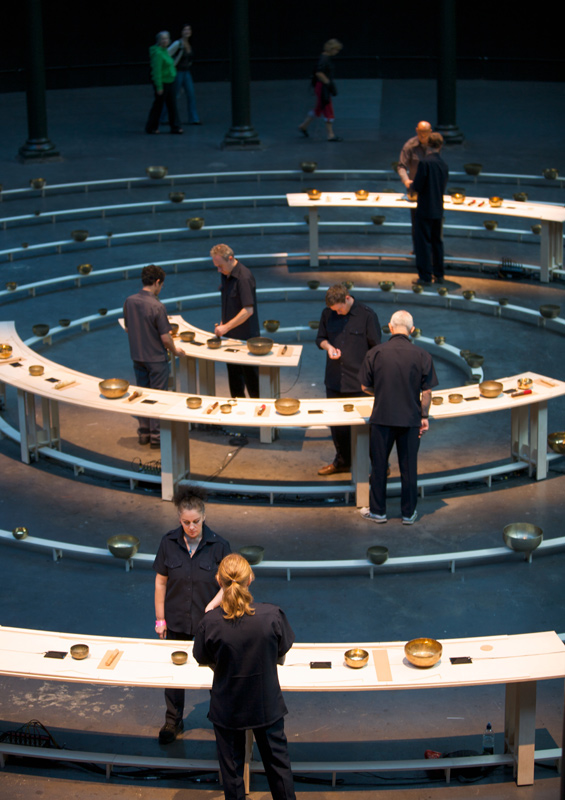
A system of live performance has since developed from this score, involving an ensemble of trained players and a vast installation of bowls arranged on circular tables, which themselves rotate around a system of concentric tracks. The first of these performances took place over 1000 minutes (16 hours 40 minutes) on 12 September 2009 – a short passage spanning roughly one 560,948th of Longplayer’s total duration. Both the methodology and the composite Longplayer Live instrument continue to develop, with sections of the instrument being completed as and when they are needed. More information about these performances is on the Live page.
Social Survival and the Longplayer Trust
The second and more abstract question about Longplayer’s future is social – who will look after Longplayer as its technological, cultural and social environments change? How does one generation of custodians go about establishing a durable chain of succession, down which the responsibility for Longplayer’s survival can realistically be expected to pass, even over hundreds of years? How many institutions have survived, with their initial objective intact, over the last thousand years?
It was clear from early in the project’s development that for its survival it would be necessary to give the work over to a group of individuals, other than the composer, who would be able to oversee Longplayer’s operation as a public artwork, and could be seen to have a collective, non-selfish investment in the project’s future.
The establishment of the Longplayer Trust, while not a complete answer to all these questions, begins by placing responsibility in the hands of a group of invested individuals. While members of the trust will change over the years, their work will always have a simple objective: to make the music available to as wide an audience as possible and to research and implement sustainable platforms for Longplayer’s future. The Trust includes individuals from the various technical and cultural fields to which Longplayer speaks and from which it has required support – experimental music, engineering, law, fine art, urban planning and regeneration, etc.
The Trust also operates as a non-profit charity on behalf of the project, and this has made it possible for the existing form of Longplayer and the research into possible future forms to be funded through charitable donations. If you are interested in helping Longplayer survive, please consider making a donation on our Support page.

